Key points
Early nutritional intervention can improve surgical outcomes in infants with cleft palate.
Specialized feeding clinics reduce complications and support healthier development.
Feeding issues in cleft palate patients are complex and often require coordinated care.
The innovation: Addressing feeding barriers before cleft repair
Orofacial clefting, which includes cleft lip and/or palate, is among the most common congenital anomalies in the United States and worldwide. As many as 63% of affected babies have trouble feeding.
“Babies born with a cleft struggle to generate enough suction to feed exclusively from the breast or a standard bottle. Before modern cleft feeding devices, it was common for children born with a cleft palate to become significantly malnourished,” says James Seaward, M.D., Plastic and Craniofacial Surgeon at Children’s HealthSM and Associate Professor of Plastic Surgery at UT Southwestern.
While feeding interventions have improved, many affected infants remain underweight, increasing the risk of poor outcomes following surgery to repair the cleft. Others require feeding tubes, which pose additional risks. To improve the outlook for babies with clefts, experts at Children’s Health developed the multidisciplinary Growth and Feeding Clinic. Research shows the approach has led to marked improvement in outcomes for underweight infants.
“Our goal is to optimize babies for surgery, so they have the best chance to heal well and avoid complications,” Dr. Seaward says. “The Growth and Feeding Clinic helps us identify feeding challenges early and support families before those challenges affect the timing and success of surgery.
Why it matters: A specialized growth and feeding clinic
Good nutrition is essential for growth and development – and for healing. Babies who are well nourished are more likely to heal well following cleft repair. “In the first few weeks after surgery, the wound is very fragile. Any breakdown can lead to scarring or fistulas, which can require additional surgeries and cause persistent problems with speech and feeding,” Dr. Seaward says.
Historically, many hospitals have addressed feeding challenges by treating babies with cleft with a nasogastric tube or surgically placed feeding tube. But feeding tubes carry an infection risk. They also interfere with the development of oral motor skills and hunger drive, leading to long-term feeding challenges and feeding tube dependence, says Cortney Vant Slot, MS, CCC-SLP, Speech Pathologist at Children’s Health. “Feeding tubes are something we want to avoid, if we can,” she adds.
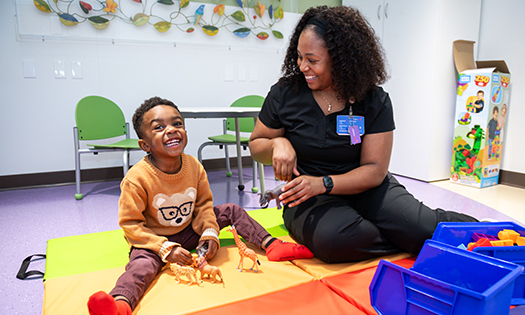
She and her colleagues launched the Growth and Feeding Clinic in 2016, hoping to reduce the need for feeding tubes and improve the nutritional status of children preparing for cleft repair. The multidisciplinary clinic includes speech pathologists, dietitians, social workers, and an orthodontist specializing in nasoalveolar molding, a technique that brings the altered tissues into better alignment in preparation for surgery. By bringing multiple specialists together in one location, the clinic streamlines care for families and helps ensure babies with feeding challenges get the targeted interventions they need.
What to know: Multidisciplinary care improves preoperative nutrition
The approach has had a positive impact. In a retrospective study published in The Cleft Palate Craniofacial Journal, the Growth and Feeding Clinic team compared children treated in the specialized clinic with those treated at the hospital before the clinic’s inception in 2016.
Among underweight children treated in the clinic, 64.1% reached normal weight by the time of their surgery, compared to just 31.8% of underweight patients in the control group. “The findings were very clear: Babies who received interventions in the clinic were twice as likely to reach a healthy weight before surgery as those who did not,” says study co-author Rami Hallac, Ph.D., Imaging Scientist and Director of the Analytical Imaging and Modeling (AIM) Center at Children’s Health and Associate Professor of Plastic Surgery at UT Southwestern.
Within the Growth and Feeding Clinic group, children who were underweight had a higher number of visits and more interventions compared to those who were of normal weight. The finding emphasized the clinic’s ability to target preoperative nutritional interventions to the highest-risk patients.
Why Children’s Health: Experts in cleft lip and palate care
The Growth and Feeding Clinic team is well established, treating an average of 75 to 90 babies each year. With the clinic’s approach validated, the team is increasing outreach to families and providers, encouraging consultations before a feeding tube is placed. “The success of our clinic shows that feeding tubes are not always necessary,” Vant Slot says. “The earlier we see these kids and get on top of their feeding, the better.”
She and her colleagues are part of a special interest group of the American Cleft Palate Craniofacial Association to help develop feeding guidelines for babies with clefts, informed by their multidisciplinary model. They are also working to expand the services they offer, including cleft services at the Children’s Health Plano Campus. The team is also preparing to add postpartum depression screening to the clinic, after noticing that many of their young patients’ mothers were struggling.
“We aim to be the hub families come to for feeding needs and care,” Vant Slot says.
Children’s Health performs the most cleft lip and palate surgeries in the region. Learn more about the Pediatric Cleft Lip and Palate Program at Children’s Health.